Epic Sagas and Spiritual Dramas in the Great Crises of History
- multi-era historical saga • major civilisational milestones (Ancient Egypt, the Crusades, World War II) • moral causality (the law of action and reaction (karma)) • reincarnation cycles and reincarnation planning • continuity of consciousness (after death) • spiritual assistance (spirit protector) and moral persecution dynamics • responsibility, reparation, and forgiveness • religion vs power / intolerance conflicts • wars, displacement, and collective trauma
These works are epic novels and historical sagas with spiritual repercussions: large-scale narratives anchored in major crises and conflicts in history, with period reconstruction and recognisable events—Crusades, the Inquisition, and World War II—treated as dramatic engines and consequence-driven axes.
The distinctive feature lies in how the metaphysical layer increases the weight of human decisions. Reincarnation cycles and moral causality structure consequence: bonds, rivalries, and choices reappear over time through processes of responsibility, reparation, and forgiveness, while spirituality operates as a backstage layer of assistance, learning, and reorientation—without reducing the central tension (power, faith, survival, identity, and ethical dilemmas under pressure).
For international acquisition: historical spiritual epic / metaphysical war-and-history drama.
ELISABETH PEREIRA — THE AUTHOR
Elisabeth Pereira (Brazil, 1968) has worked as a psychographic medium since childhood, when she established contact with the spiritual dimension. At the age of 20, she began studying mediumistic phenomena, attending study centres and developing her practice in Oliveira, Minas Gerais (Brazil).
In this catalogue, we present a selection of 3 works published by Viva Luz. Reported sales across a total of 5 works exceed 75,000 copies.
Editorially, her production asserts itself as an epic historical saga with spiritual repercussions: Ancient Egypt, the Crusades, and World War II function as moral proving grounds in which individual choices carry consequence and in which responsibility, reparation, and inner transformation become the narrative axis.
For international acquisition: historical spiritual epic / metaphysical war-and-history drama.
SOPHIE — SPIRIT AUTHOR (as presented)
Sophie is a spiritual voice anchored in the tradition of Kardecist codification, within the nineteenth-century context in which Hippolyte Léon Denizard Rivail (Allan Kardec) systematised the investigation of mediumistic phenomena and communication between the deceased and the living.
The Sophie signature stands out for large-scale historical sagas in which recognisable milestones—Ancient Egypt, the Crusades, World War II—do not function as background but as dramatic force: collective history pressures individual choices, and decisions reverberate through cycles of consequence, reparation, and transformation.
In her last earthly life, Sophie lived in Brazil and worked in favour of the liberation of enslaved people—a biographical trait consistent with the thematic core of her work: justice, responsibility, and rebuilding.
For international acquisition: historical spiritual epic / metaphysical war-and-history drama.
EDITORIAL AXES (Sophie signature)
- epic historical saga • major crises in history • moral causality (the law of action and reaction (karma)) • reincarnation cycles and responsibility • the spiritual dimension as backstage to conflict • reparation and inner transformation
BOOKS (selection of 3)
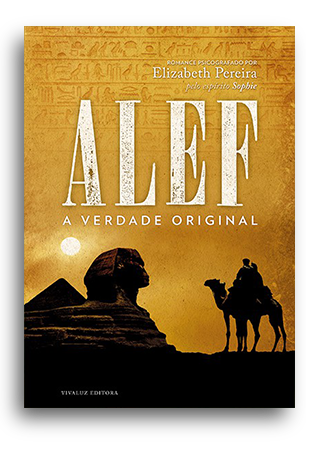
Alef: The Original Truth (Alef — A Verdade Original, 2014)
EDITORIAL CLASSIFICATION
Historical novel (Ancient Egypt) • Epic and initiatic saga • Spiritual realism and cosmology • Moral causality (the law of action and reaction (karma))
MINIMUM TECH SHEET
Author (psychography): Elisabeth Pereira • Spirit author (as presented): Sophie
Year: 2014 • Publisher: Viva Luz • Extent: 438 pages
Reported data: sales (to Jul/2017): 25,000
CONTEXT / HISTORICAL FRAME
Ancient Egypt — 29th Dynasty, reign of Hakor (392 BCE).
WORK PRESENTATION (3 paragraphs)
Alef: The Original Truth takes the reader to Egypt at the end of the pharaonic period, during the reign of Hakor, when politics, worship, knowledge, and power intertwine amid civilisational decline and religious tension. The novel follows the social mechanisms of the period and the motivations of its protagonists within a historically dense setting.
At the centre of the plot, Haemon—an Athenian Greek and advisor to the pharaoh—brings together reason, knowledge, and spiritual perception as he navigates conspiracies and dilemmas of conscience. Egyptian culture (rites, death, temples, mummification) becomes a dramatic key to a larger question: what was the civilisation trying to preserve—and why?
By extending the arc beyond a single lifetime, the novel connects remote past, bonds, and consequence, developing a spiritual cosmology in which individual decisions reverberate across long cycles of reparation and moral maturation.
INTERNAL STRUCTURE
- Period novel set in Ancient Egypt (392 BCE)
- Conspiracy/power dynamics and dilemmas of loyalty
- Spiritual realism: communication between planes and continuity of consciousness
- Multi-era arcs: bonds, rescue, and moral transformation
CONCEPTUAL DIMENSION
Historical-spiritual saga: uses a civilisational milestone to discuss memory, responsibility, and consequence, connecting culture, power, and ethics within a reincarnational architecture.
STYLE AND LANGUAGE
Epic-scale historical reconstruction prose, combining adventure and inquiry, with spiritual elements integrated into the movement of the plot.
INTERNATIONAL POTENTIAL
Historical spiritual epic • Ancient Egypt saga • Metaphysical moral-causality fiction.
The thematic axis—civilisation, power, and moral consequence across a multi-era arc—has universal resonance.

The Second Great Link: The Army No One Saw (O Segundo Grande Elo — O Exército Que Ninguém Viu, 2013)
EDITORIAL CLASSIFICATION
Historical saga (World War II) • Spiritual rescue drama • Mission and service in invisible backstage • Moral causality (the law of action and reaction (karma))
MINIMUM TECH SHEET
Author (psychography): Elisabeth Pereira • Spirit author (as presented): Sophie
Year: 2013 • Publisher: Viva Luz • Extent: 728 pages
Reported data: sales (to Jul/2017): 12,000
CONTEXT / HISTORICAL FRAME
World War II — historical fronts and episodes (Europe, North Africa, and the Pacific), with spiritual action in parallel to events.
WORK PRESENTATION (3 paragraphs)
In this saga, Sophie leads a group of rescuers on the spiritual plane operating at the heart of World War II, forming a “unit” of relief and mercy amid human collapse. The narrative crosses historical episodes and the intimate experience of soldiers and civilians confronted with fear, rupture, and loss.
The novel turns the war setting into a field of moral consequence: personal dramas connect to bonds and mistakes from other existences, and each mission makes explicit the tension between barbarity and conscience, hatred and compassion, despair and the possibility of rebuilding.
At the end of each arc, the work reinforces service as a path to liberation: characters move through fall, learning, and reparation, transforming former moral positions into a trajectory of assistance to others.
INTERNAL STRUCTURE
- World War II historical episodes as plot milestones
- Parallel spiritual line: rescue, reception, and assistance
- Bonds and consequence: reincarnational past as a dramatic engine
- Moral transformation: service, forgiveness, and rebuilding
CONCEPTUAL DIMENSION
A service drama in collective crisis: uses war to discuss responsibility, moral justice, and reparation, linking historical suffering to processes of conscience and ethical liberation.
STYLE AND LANGUAGE
Historical saga prose with episodic rhythm and broad geographic scope, sustained by moral tension and spiritual backstage as a narrative layer.
INTERNATIONAL POTENTIAL
Historical spiritual epic • World War II metaphysical drama • Rescue-and-redemption narrative.
The thematic axis—war, service, and moral transformation—has universal resonance.

Red Horizon (Red Horizon, 2012)
EDITORIAL CLASSIFICATION
Epic historical saga (the Crusades) • Drama of religious intolerance and power • Adventure-romance with a spiritual layer • Moral causality (the law of action and reaction (karma))
MINIMUM TECH SHEET
Author (psychography): Elisabeth Pereira • Spirit author (as presented): Sophie
Year: 2012 • Publisher: Viva Luz • Extent: 638 pages
Reported data: sales (to Jul/2017): 35,000
CONTEXT / HISTORICAL FRAME
The Crusades — conflict and religious intolerance across a long-duration historical setting, structured in four parts.
WORK PRESENTATION (3 paragraphs)
Red Horizon enters some of the darkest moments in the history of religious intolerance, with the Crusades as its historical and dramatic axis. The work combines history, adventure, and drama, building a four-part epic arc.
The novel treats the conflict as an extreme human experience: faith and power, belonging and violence, loyalty and rupture—tensions that cut across characters and collectives. The spiritual layer expands the moral reading of the period, linking choices, bonds, and consequences within a horizon of responsibility and reparation.
By weaving romance, suspense, and spirituality, the narrative sustains the momentum of saga: historical events pressure intimate decisions, and inner transformation is shaped as a response to civilisational shock.
INTERNAL STRUCTURE
- Four-part historical saga (the Crusades)
- Religion vs power and intolerance as the dramatic core
- Epic-scale adventure-romance and suspense
- Spiritual layer: moral consequence, bonds, and reparation
CONCEPTUAL DIMENSION
A civilisational-shock saga: uses history to discuss intolerance, responsibility, and ethical transformation, linking collective violence to moral consequence and the possibility of rebuilding.
STYLE AND LANGUAGE
Epic narrative with adventure, romance, and suspense components, sustained by four-part progression and integration of spiritual elements into the central conflict.
INTERNATIONAL POTENTIAL
Historical epic • Crusades-era spiritual drama • Adventure/romance with metaphysical layer.
The thematic axis—intolerance, power, and moral rebuilding—has universal resonance.